All | Storytelling

Meri Maut

Spotlight Forum and Jashn-e-Qalam present Khwaja Ahmad Abbas’ –

MERI MAUT
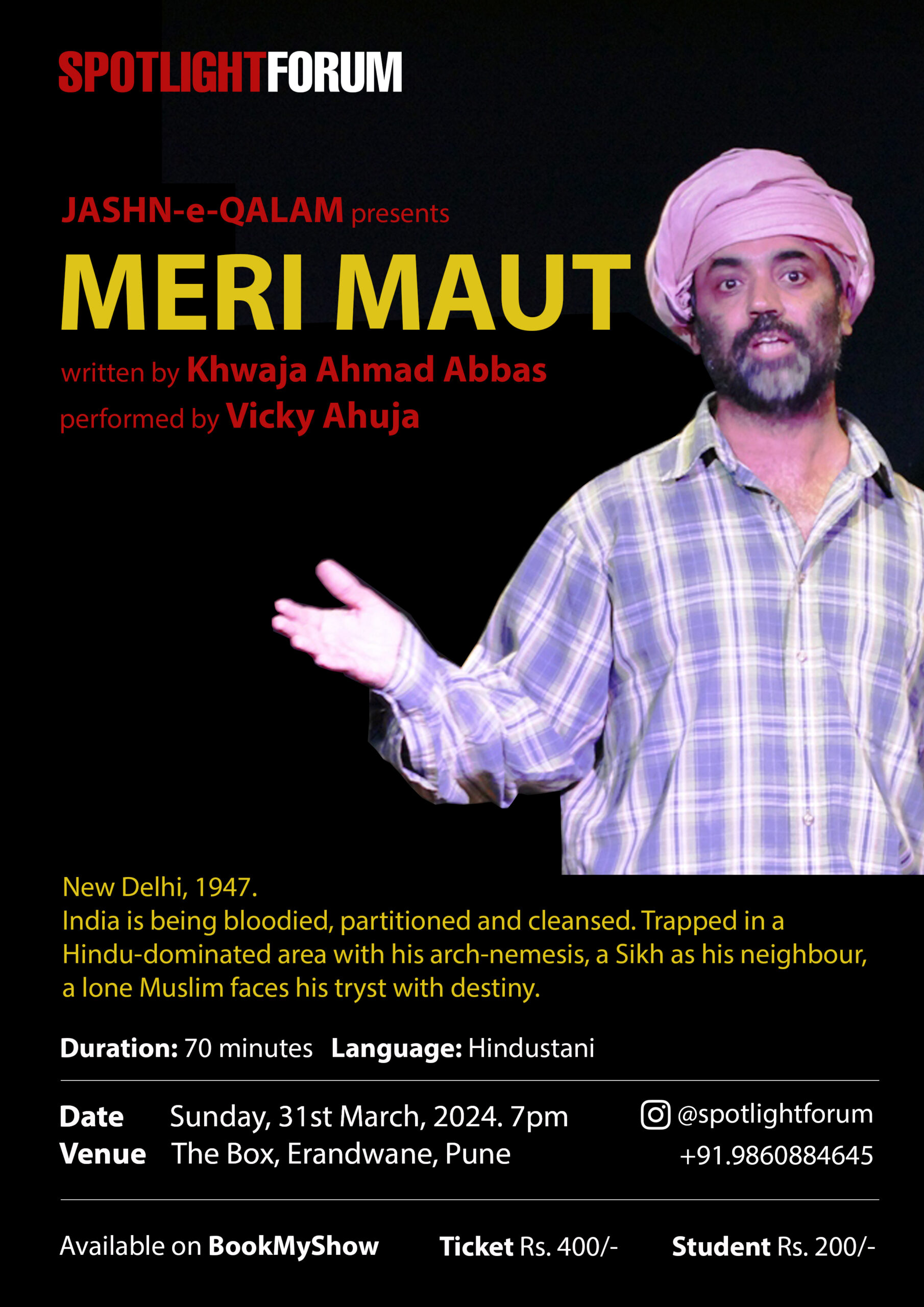
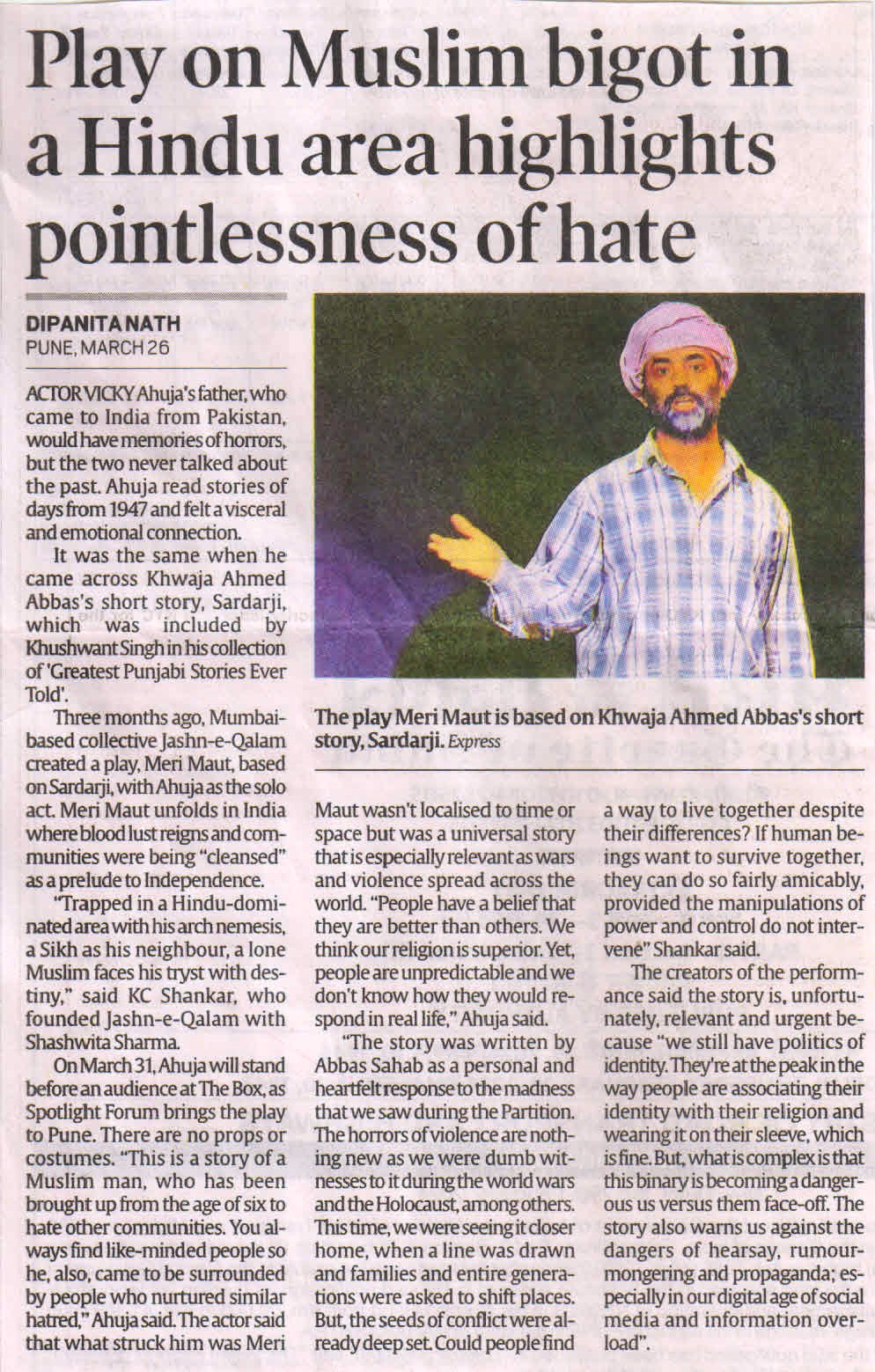
New Delhi, 1947. India is being bloodied, partitioned, and cleansed. Trapped in a Hindu-dominated area with his arch-nemesis, a Sikh as his neighbour, a lone Muslim faces his tryst with destiny.

Sunday 31st, March 2024
| 7 PM

120 minutes | Language English

The Box, Erandwane, Pune

Details

Event Information

Spotlight Forum and Jashn-e-Qalam present Khwaja Ahmad Abbas’ – MERI MAUT

New Delhi, 1947. India is being bloodied, partitioned, and cleansed. Trapped in a Hindu-dominated area with his arch-nemesis, a Sikh as his neighbour, a lone Muslim faces his tryst with destiny.
“Thus, we step across the bloody threshold of history. And we shall be better able to find our way in the future if we have a clearer perspective of the past. For the past lives in the present and the present in the future. There is neither end nor beginning.” ~ Khwaja Ahmad Abbas

Synopsis: An exploration of the values of harmony, brotherhood and peace, this short story was written as a personal and heartfelt lamentation of the violence and mayhem the country witnessed in the wake of Partition. Published, almost 75 years ago, under the title ‘Sardarji’, it received encouraging acclaim and acceptance but was also mercilessly attacked by all the three religious communities it addressed (ironically, for hurting their respective sentiments). The author was also dragged to the Allahabad High Court from where he was eventually, honourably acquitted, with due intervention by Pandit Jawaharlal Nehru and Sarojini Naidu.

Since then, ‘Meri Maut’ has been celebrated as one of the finest examples of humanistic literature by its innumerable readers and admirers. Khushwant Singh, included it in his collection of ‘Greatest Punjabi Stories Ever Told’, and said “No other short story has been able to portray Sikh character and the tragedy of the Partition with such poignancy”. The story continues to serve as a much-needed cautionary warning to the dangers of othering, rumour mongering and communalism, while appealing to our better natures and sensitivities, asking us to look beyond our deep-set conditioning, biases and prejudices.

Aritsts

About the Writer, Khwaja Ahmad Abbas: With 74 books, 90 short stories, 3,000 journalistic articles, 45 films and several plays to his name, K.A. Abbas was as prolific as he was progressive. As a director and screenwriter, he is considered as one of the pioneers of Indian parallel or neo-realistic cinema. His debut film, Dharti Ke Lal (1946), about the Bengal famine of 1943, opened the overseas market for Indian films in the Soviet Union.

This was followed by films like Neecha Nagar (1946) which won the Palme d’Or at the first Cannes Film Festival, Naya Sansar (1941), Jagte Raho (1956) which won the Crystal Globe at Karlovy Vary International Film Festival, Pardesi (1957) which was nominated for the Palme d’Or, Shehar Aur Sapna (1963) which won the National Film Award for Best Feature Film, while Saat Hindustani (1969) and Do Boond Pani (1972) both won the National Film Awards for Best Feature Film on National Integration.

He is also known for writing Raj Kapoor’s films, including the Palme d’Or-nominated Awaara, as well as Shree 420, Mera Naam Joker, Bobby and Henna. He was awarded the Padma Shri in 1971, and the Dadasaheb Phalke Award in 1989.

About the Artist, Vicky Ahuja: Vicky Ahuja works as a professional actor in various media. After working extensively in theatre for 4 years in Delhi, he moved to Mumbai. Since then, he has worked in more than 25 plays across India, with well-known directors such as Makarand Deshpande & Ashok Purang. His film credits include Bhagat Singh, Veer Zaara, Raaz 2, 1920 Evil Returns & Firaaq. In Television, he has appeared in shows like Daayan, Meri Durga, Crime Patrol, CID, Who and Hip Hip Hurray.

About Jashn-e-Qalam: Through the craft of storytelling — the oldest form of theatre, practiced since the dawn of civilization, Jashna-e-Qalam takes the spirit of Hindustani literature to audiences in different contexts and venues. The introspective and interactive nature of their shows results in the creation of a space for dialogue and introspection.

Press